Constituency Boundaries and Representation in Ireland






The Republic of Ireland is a parliamentary, representative democracy. This means citizens vote to elect representatives, Teachta Dála (TDs), to our legislative body, the Dáil. Article 16.2° of the constitution defines how people should be represented by a TD.
16.2° The number of members shall from time to time be fixed by law, but the total number of members of Dáil Éireann shall not be fixed at less than one member for each thirty thousand of the population, or at more than one member for each twenty thousand of the population.
The article defines the number of people a TD can represent to between 20,000 and 30,000. By taking the population at the time of the last census, and dividing it by 20,000 and 30,000, we get the constitutional range of TDs Ireland can have.
Because the population changes over time, the number of TDs change too. For example, the 2016 census reported a national population of 4,761,865 people. This meant the range of TDs in the Dáil had to be between 159 (4,761,865/30,000) and 238 (4,761,865/20,000). In 2017, the commission in charge of deciding the number of TDs arrived at the number of 160 TDs. This put it just within the constitutional range.
When the 2022 census came out with an increased population of 5,149,139, with only 160 TDs, the 30,000 person limit per TD threshold was exceeded.

It’s the job of the Electoral Commission to choose a new number of TDs to represent the people and bring representation back into the constitutional range. The new census population data meant that the range of TDs given the population was between 171 and 257. This was limited further in the Electoral Reform Act 2022 (section 57.2.a) to between 171 and 181. This gave ten possibilities for the number of TDs.
One of the TDs will be appointed as Ceann Comhairle, the chairperson of the Dáil. The Ceann Comhairle can only vote in the event of a tie, so an even number of TDs should be picked to minimize the number of tied votes in the Dáil. This leaves five possibilities for the number of TDs in the next Dáil.
Now the commission knew roughly how many TDs the country should have, they had to decide where to put them.
# Constraints
A constituency is a geographical area represented by at least one member in a legislative body e.g. the Dáil. A constituency can be any shape or size. However, there are constraints, or provisions, that limit constituency boundaries.
# 1. Number of TDs per constituency
Article 16.2.6 of the constitution requires that there must be a minimum of three TDs per constituency. The Electoral Reform Act 2022 limits this to between three and five. Given the 20,000 to 30,000 people per TD range, this means a constituency should have between 60,000 (20,000 * 3) and 150,000 (30,000 * 5) people. This limit means it’s not always possible for a single county to be made up of just one constituency. Instead, a county might have to consist of multiple constituencies.
# 2. Avoid County Boundary Breaches
Many people feel proud of their county and strongly identify with it. Ideally, all constituencies would be entirely within the boundaries of a county. This isn’t always practical. There could be a situation where it makes sense for a constituency boundary to breach a county boundary.
If a constituency breaches a county boundary, people can feel their voices are not heard as much as others in the constituency, especially if the breach makes the voters in one county a small minority, or if fewer of the constituency TDs are from their county. If a county boundary is being breached, some feel it’s better to make a big breach to increase representation, but better still to have no breach at all.
# 3. Contiguous
A constituency should have geographic continuity of the area. All parts of the constituency are physically adjacent and connected to each other. There are no disjointed or separate pieces of land that make up the constituency.
# 4. Geography
Constituency boundaries should be made with geographic considerations including significant physical features, such as rivers and mountains. Using these features makes clear and natural boundaries.
The extent and density of population also needs to be considered. This means that in areas of low population density, the number of TDs should be minimized. Better to have three TDs in a small, low density area than five TDs in a huge, low density area. And the inverse, in general, it’s better to have constituencies with many TD seats in areas of higher population density.
# 5. Continuity
Boundaries of a constituency should be somewhat stable over time. It’s possible that there could be a complete overhaul of boundaries that would better meet all of the constraints required for the boundaries but this should be avoided.
Continuity in constituency boundaries helps voters become familiar with their electoral district and their representatives. Frequent changes can lead to confusion and disengagement from voters, and can end political careers if the TD is shifted into a constituency they haven’t built support in.

It might be tempting to future-proof and increase the number of TDs to the maximum so fewer changes need to be made in future boundary reviews but future-proofing is not one of the provisions of creating new constituency boundaries whereas continuity is, which encourages the fewest changes possible to meet the required level of representation.
Of course, total continuity won’t be possible as the population changes and population limits are exceeded. Some boundaries have to be updated.
# Updating Boundaries
Electoral divisions are the building blocks of a constituency. Let’s take the Kimmage area in Dublin to better understand electoral divisions.

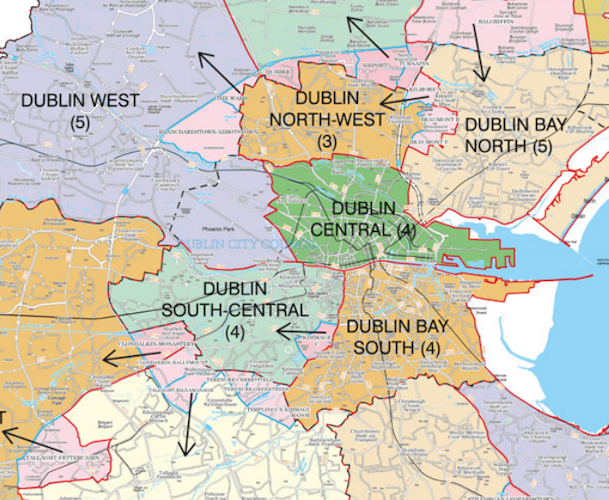
The Kimmage area is broken into electoral divisions, named Kimmage A through E. Electoral divisions for an area don’t have to be in the same constituency. For example, Kimmage C here is part of Dublin Bay South while the other Kimmage electoral divisions are in Dublin South-Central.
If there was population growth in Dublin Bay South, rather than increasing the number of TDs from four to five, the commission could instead transfer electoral divisions out of the constituency. Kimmage C and Terenure A would be among the candidates. The commission might decide to move Kimmage C. This would create two new constituency boundaries for Dublin Bay South and Dublin South-Central.

Redefining boundaries might be straight-forward when only considering two constituencies but things can become complicated because few changes are made in isolation and any change made to one constituency could have knock-on effects spreading throughout the county.

Transferring electoral divisions to a constituency might cause that constituency to exceed a population threshold, which can require chaining transfers between many constituencies. This might exacerbate a county border breach issue.
There could be a situation where having six TDs in a constituency would be ideal but the limit has been set at five. On top of this, there might be no great options if a constituency is hemmed in with natural boundaries and electoral divisions have already been transferred to fix problems elsewhere. This can make it all seem close to impossible to create fair new boundaries, but there’s one powerful tool that the commission can use to make things work - variance.
# Variance
The constitution requires the ratio of TDs to population to be the same throughout the country, so far as it is practical. It’s practically impossible for every TD to represent exactly the same number of people. Some TDs will represent more people and some TDs will represent fewer people. The national average is the average number of Ireland’s population that each TD represents. The deviation from the national average is known as the variance.
For example, the national average is some number between 20,000 and 30,000, let’s say 29,000. The Clare constituency has a population of about 130,000 people and has four TDs, giving around 31,250 people per TD. This gives Clare a 7% variance from the national average per TD. It can work the other way too. The Kildare South constituency has about 109,000 people represented by 4 TDs, giving around 27,500 people per TD, more than 5% variance from the national average population per TD.
Because more people are being represented by a TD in Clare, the vote of a person in Clare has less weight than a vote from a person Kildare South in the election of their TDs. This inequality of representation is very serious. However, Irish courts have determined that it’s a practical necessity to create sensible boundaries. Although some constituencies may be under or overrepresented, the total number of TDs per population of the whole country should still be within the constitutional limits.
There is no variance threshold set in the Constitution or legislation. The commission tries to minimize variance but needs some leeway, especially if the alternative is something worse, like a breach of county boundaries.
# Recommendations
The commission’s 2023 recommendations would reduce the number of county boundary breaches from 10 (Donegal, Galway, Laois, Mayo, Meath (2), Offaly, Roscommon, Tipperary, Westmeath) to 6 (Donegal, Galway, Kilkenny, Meath, Wexford and Wicklow).
To better understand these recommendations, let’s look at two county boundary breaches the commission considered - the Laois-Offaly constituency and the Donegal constituency.
There were five TDs for the 2017 Laois-Offaly constituency. With population growth, it couldn’t remain a five seat constituency without substantial electoral division transfers out.

By taking four electoral divisions from the Kildare-South constituency, the Laois-Offaly constituency was broken into a low variance, three TD Laois constituency with boundaries that fully align with the country boundaries.

The three seat Offaly constituency was formed by transferring one electoral division from Kildare South and resulted in constituency boundaries matching the county boundaries.

The Laois-Offaly split was clean and fairly straight-forward but now let’s look at a county boundary breach the commission decided to keep.

In Donegal, there’s a county boundary breach. This one’s a bit more complicated. Nine of the electoral divisions in county Donegal are in the Sligo-Leitrim constituency.

The breach was kept and the number of TDs remained at five. Removing the breach would have required moving nine electoral divisions out of the Sligo-Leitrim constituency and into the Donegal constituency.

This would have added substantially to the Donegal population, increasing the Donegal constituency variance to nearly 13%, an amount the commission thought was too high.
The commission also considered breaking Donegal into two three TD constituencies but this would have prevented removing the county boundary breach in northern Roscommon. The commission wanted to take the Roscommon-Galway electoral divisions out of Sligo-Leitrim because Sligo-Leitrim contained electoral divisions from four different counties and moving these divisions to Roscommon would bring it down to three counties instead, a worthwhile improvement.

This is a simplified version of the considerations made but it’s clear how one small change can cause a chain reaction that can easily spread halfway around the country, strongly violating the continuity constraint. Border breaches are hard problems!
The commission also recommended 43 Dáil constituencies instead of 39, creating new constituencies either to fix county boundary breaches, such as the case of Laois and Offaly, or because the population couldn’t fit in the existing constituency, such as splitting Tipperary into Tipperary North and Tipperary South.


The number of 3 seat constituencies would be 13 instead of 9, the number of 4 seat constituencies would be 15 instead of 17, and the number of 5 seat constituencies would be 15 instead of 13.
Seven breaches of county boundaries would be removed, two existing breaches reduced, one breach remains as is and three new breaches were proposed.
In the end, the commission recommended increasing the number of TD from 160 to 174. This change brings us just back within the constitutional range of population per TD and leaves.

# Opinion
First off, having an independent commission is so much better than letting the politicians make the borders. There’s no gerrymandering.

In my opinion, the commission and agencies involved did a very good job with these changes. The ratio of TDs to population is back in the constitutional range, the new boundaries are generally better than the old ones, and there’s strong continuity with the last set of boundaries. That said, there are some changes I would like to see.
I want more opportunities for participation. I would like if once the census results are in, several machine-readable files (Excel, JSON etc.) are released to the public. These would be the same files the commission themselves use when making decisions. Using these files, universities, organizations and enthusiastic citizens could write programs that could generate sets of constituency arrangements shared with the public and considered by the commission.
I’d also like it if the commission could present a proposal before the public submits their comments. The current approach doesn’t give people anything concrete to comment on. Even though it’s clear from reading the report that the commission read and considered each submission, right now the process feels a bit one-sided. A big downside I could see if they did this is that any politician or party adversely affected by the new boundaries would scream bloody murder because their job is on the line.
I’d like to lift the cap on five seat constituencies. The Electoral Reform Act 2022 limited it to five but I don’t see any good reason for this. The population of the country is growing, particularly in cities. Having six and seven seat constituencies would give more options. Ireland has previously had a constituency with nine TDs. More seats per constituency would give more democratic outcomes.
This leads me to what I want most - more many seat constituencies. We all have biases when it comes to setting these constituency boundaries. Some people prize county boundaries being respected, some favor continuity, I think proportional democratic representation is most important.
In a constituency election, the most popular parties will fill seats first. If there aren’t many seats, there are none left for smaller parties. If this is repeated throughout the country, less popular parties will be underrepresented. I’d like it if a party that received 5% of the vote nationally ended up with about 5% of Dáil seats.
If you’re interested in learning more about constituency boundary redraws, I recommend Michael Gallagher’s article about the optimal number of TDs,

this paper from John Coakley for a completely different approach to boundary setting,

and most of all, the electoral commission’s constituency review report.
